History of Bruce Springsteen
Bruce Springsteen
Bruce Springsteen emerged in the early 1970s as one of the most distinctive American songwriters of his generation, combining rock and roll energy with literary ambition and a deep interest in working-class life. Born in New Jersey in 1949, he developed a reputation for dense, vivid storytelling, often writing songs that felt like short films about loneliness, hope, labor, escape, and the moral costs of American life. His early records introduced him as a major talent, but his long-term significance came from the way he steadily expanded his range while keeping his voice grounded in ordinary experience.
Springsteen’s rise was built on strong live performance, particularly with the E Street Band, whose marathon concerts helped create the image of Springsteen as both a rock star and a laboring artist. Albums such as Born to Run and Darkness on the Edge of Town established his reputation for combining big sound with emotional seriousness. He became known for songs that sounded triumphant even when they were about disappointment, and for performances that treated rock music as a vehicle for endurance and confession.
In the 1980s, Springsteen reached a broader audience while also deepening the complexity of his work. Born in the U.S.A. became one of the most commercially successful albums of the decade, though its political and emotional meaning was often misunderstood because of its anthemic production. At the same time, he released more intimate work such as Nebraska, which revealed how effective he could be with little more than voice, guitar, and atmosphere. That balance between stadium-scale energy and stripped-down storytelling became one of his defining traits.
Springsteen’s career also became notable for its refusal to stay in one mode for long. He alternated between band-driven rock, solo acoustic writing, political commentary, and elegiac reflection. His recordings often functioned as chapters in a larger American narrative, one in which the promise of mobility is always shadowed by loss, responsibility, and social strain. Because of that, his work has been studied not only as popular music but also as an ongoing cultural portrait of the United States.
By the 2000s, Springsteen had already achieved the rare status of being both a massive mainstream figure and a respected critical voice. Albums like The Rising connected his songwriting to public trauma and recovery, while later records continued to revisit the themes that had always driven his music: family, memory, labor, faith, aging, and the tension between private feeling and public myth. He remained prolific, but he also grew more reflective, often treating each album as an argument about how to live with history.
One of the most important aspects of Springsteen’s history is the way he keeps reinventing his voice without abandoning his core identity. His records may change in tone and arrangement, but they usually preserve a few essential qualities: narrative detail, emotional directness, and a belief that music can testify to ordinary lives with extraordinary seriousness. That consistency has helped make him one of the most durable figures in American popular music.
Springsteen’s legacy is also inseparable from his relationship with performance and audience. He has long been admired for concerts that feel communal, almost ritualistic, where songs become shared acts of memory and affirmation. Over time, this has made him more than a recording artist; he is often treated as a chronicler of American experience whose work can speak across generations. His importance lies not only in the songs themselves but in the moral imagination that connects them.
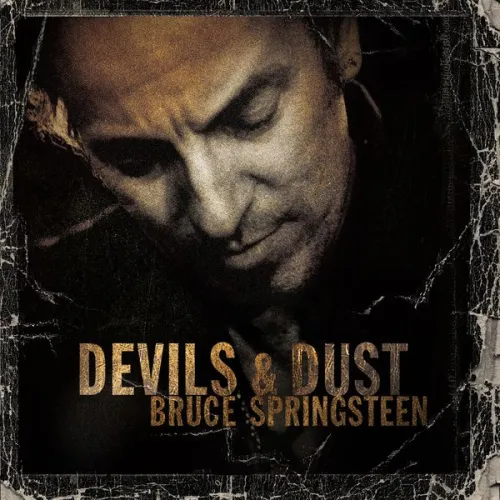
Devils & Dust
Devils & Dust is the thirteenth studio album by Bruce Springsteen and one of the most intimate and restrained records of his career. Released in 2005, it followed the larger, more communal sound of The Rising and returned to a more solitary mode of writing and performance. The album is often described as a folk-centered, mostly acoustic work that revisits the quiet severity of Nebraska and the reflective storytelling of The Ghost of Tom Joad, while adding new layers of maturity and emotional wear.
A major feature of the album is its sense of accumulated history. Many of the songs were written years earlier, some dating back to the 1990s, which gave the record the feeling of a long-shelved emotional archive finally brought into focus. Springsteen did not present it as a concept album, but the songs share concerns with displacement, guilt, family, war, migration, labor, and spiritual exhaustion. This creates a cohesive atmosphere even though the material comes from different periods in his creative life.
Sonically, the album is notable for its sparse textures and careful use of instrumentation. Springsteen often plays guitar, harmonica, and other supporting parts himself, while Brendan O’Brien’s production helps preserve clarity without polishing away the roughness. The record’s quiet intensity comes from its refusal to force drama; instead, it lets the lyrics and vocal delivery carry the emotional weight. That approach makes the album feel more like confession than performance in many places.
Its title track is one of the album’s most powerful statements, establishing the tonal world of the record with imagery of fear, vulnerability, and moral tension. Other songs, such as “Long Time Comin’,” “The Hitter,” “Matamoros Banks,” and “Maria’s Bed,” show Springsteen working in a stripped-down style that favors character study and moral ambiguity. Even when the songs are rooted in specific narratives, they carry a broader sense of national unease and personal reckoning.
The album debuted at number one in the United States, which underscored Springsteen’s continuing commercial reach even when he moved into a quieter and less radio-friendly mode. Critics generally responded positively, praising its honesty, subtlety, and emotional force. Some listeners found it more uneven than his classic records because of its subdued mood, but that same restraint is one reason others value it highly: it feels deliberate, inward-looking, and unusually unadorned.
Devils & Dust also occupies an important place in Springsteen’s broader history because it demonstrated how deeply he could return to solo storytelling without repeating himself mechanically. The album is not simply a revival of his earlier acoustic work; it is a mature meditation on distance, loss, and the difficulty of remaining compassionate in a damaged world. That makes it one of the more serious and philosophically weighted entries in his catalog.
Over the years, the album has grown in reputation as listeners have come to appreciate its patient structure and its refusal to conform to standard commercial expectations. It stands as a record that rewards close listening rather than immediate gratification. In the context of Springsteen’s career, it is a statement of artistic independence and emotional discipline, one that shows how far his writing could go with very few musical resources.
Urban Legends
One recurring story is that many of the songs on Devils & Dust were left over from earlier sessions and only found their final shape years later, which gives the album a mythic “lost chapters” quality. Another common piece of commentary is that the record was made in part as a deliberate retreat from the arena scale of Springsteen’s more famous work, almost as if he were testing how much meaning could be carried by understatement alone.
There is also a persistent fan belief that the album’s title reflects an unusually dark personal and political mood after the early 2000s, turning it into a symbolic map of post-9/11 anxiety and private doubt. That reading is not the only way to understand the record, but it has become part of the album’s public legend.
Track list
- Devils & Dust — 4:58.
- All the Way Home — 3:39.
- Reno — 4:05.
- Long Time Comin’ — 4:16.
- Black Cowboys — 3:03.
- Maria’s Bed — 5:30.
- Silver Palomino — 3:15.
- Jesus Was an Only Son — 2:54.
- Leah — 3:30.
- The Hitter — 4:02.
- All I’m Thinkin’ About — 4:21.
- Matamoros Banks — 6:59.
Bruce Springsteen albums
- Greetings from Asbury Park, N.J. (1973).
- The Wild, the Innocent & the E Street Shuffle (1973).
- Born to Run (1975).
- Darkness on the Edge of Town (1978).
- The River (1980).
- Nebraska (1982).
- Born in the U.S.A. (1984).
- Tunnel of Love (1987).
- Human Touch (1992).
- Lucky Town (1992).
- The Ghost of Tom Joad (1995).
- The Rising (2002).
- Devils & Dust (2005).
- We Shall Overcome: The Seeger Sessions (2006).
- Magic (2007).
- Working on a Dream (2009).
- Wrecking Ball (2012).
- High Hopes (2014).
- Western Stars (2019).
- Letter to You (2020).


The best music in Hi-Res
Enjoy uncompromising sound quality of this album.
Try it now