History of Supertramp
Supertramp emerged in the late 1960s and early 1970s as one of the most distinctive British progressive rock bands, eventually developing a sound that balanced complex arrangements with unusually strong pop instincts. Founded by Rick Davies and Roger Hodgson, the group moved through several stylistic phases before settling into the blend of keyboards, saxophone, layered harmonies, and narrative songwriting that would define its most successful era. Their music was always marked by contrast: Davies brought a grittier, blues-rooted sensibility, while Hodgson contributed a more melodic, reflective, and often spiritually inclined voice.
The band’s early albums established them as an ambitious but still evolving act. Over time, they refined their writing so that long-form structures could still yield memorable hooks and singable choruses. This balance proved crucial to their later success, because it allowed them to reach a broad audience without abandoning the architectural complexity that made them interesting in the first place. Supertramp became especially known for songs that felt polished but not sterile, intellectual but not cold.
Their commercial breakthrough came with the 1974 album Crime of the Century, which helped define the band’s identity and brought them a lasting international audience. That record combined dramatic piano writing, emotional themes, and a strong sense of production detail, setting the template for the work that followed. By the mid-1970s, Supertramp had become one of the leading names in sophisticated rock, capable of both critical respect and mainstream reach.
As the band progressed, they increasingly mastered the art of writing records that worked as complete listening experiences. Albums like Crisis? What Crisis? and Even in the Quietest Moments... showed a group capable of creating atmosphere across an entire side of vinyl. Their attention to sequence, pacing, and tonal variety helped them stand apart from groups that relied mainly on single songs. They were building albums as carefully as they were building tracks.
The late 1970s and early 1980s brought Supertramp’s greatest commercial success. Breakfast in America became one of the defining pop-rock albums of the era, yielding massive hits and huge global sales. It also showed how far the band could push accessible songwriting without losing its identity. Even as lineup tensions grew, the group’s records remained highly influential for their precision, melodic clarity, and studio craftsmanship.
Supertramp’s later history involved lineup changes, pauses, reunions, and shifts in public attention, but the band’s core catalog remained durable. Their work continued to attract listeners who appreciated albums with strong structure, emotional intelligence, and a distinctive sonic signature. The contrast between Davies and Hodgson, along with the band’s skill in balancing keyboard-driven textures with rock dynamics, remains central to how they are remembered.
In historical terms, Supertramp occupies a special place between progressive rock and mainstream pop. They were not as sprawling as some prog bands, nor as lightweight as many radio acts, and that middle ground became their strength. Their history is one of careful evolution, where technical detail and broad appeal consistently met in the same songs.
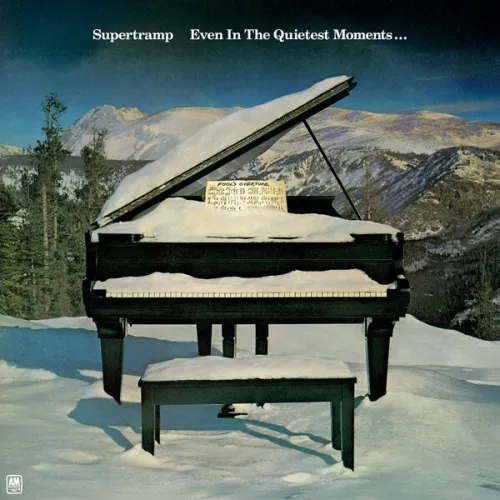
Even In The Quietest Moments...
Even in the Quietest Moments... is the fifth studio album by Supertramp and one of the most elegant records in the band’s catalog. Released in 1977, it marked an important stage in the band’s development, showing a group that had learned how to combine emotional subtlety, progressive structure, and pop accessibility in a more unified way than before. It is often seen as a bridge between the more ambitious early records and the larger commercial success that would follow.
The album was recorded mainly at Caribou Ranch in Colorado, with additional overdubs, vocals, and mixing completed at the Record Plant in Los Angeles. This production journey contributed to its polished yet spacious sound, which feels both carefully crafted and open enough to breathe. The first release to use engineer Peter Henderson, it also helped establish a sonic relationship that would continue on the next several Supertramp albums.
One of the album’s defining qualities is the way it combines intimacy and scale. Songs like “Give a Little Bit” and the title track are immediately memorable, but they sit alongside longer, more meditative pieces such as “From Now On” and “Fool’s Overture.” The record therefore functions both as a collection of songs and as a flowing sequence, with each side of the original vinyl format offering its own emotional arc.
Give a Little Bit became the album’s major hit, reaching the US Top 20 and helping to raise the band’s profile significantly. At the same time, album-oriented radio embraced the title track and “Fool’s Overture,” which gave the album a broader reputation than a single hit alone could provide. The success of the record also showed that Supertramp could produce music that was thoughtful and expansive without losing radio appeal.
Critically, the album is often praised for its balance. It contains enough emotional directness to feel accessible, but enough arrangement detail to reward close listening. The use of keyboards, acoustic textures, and saxophone gives it an airy, reflective quality that aligns well with the album’s title, as if the music were inviting listeners into a quieter emotional space rather than a louder, more theatrical one.
Over time, the record has remained important because it captures Supertramp at a point of rising confidence. The group had already developed a clear identity, but here that identity feels more refined and assured. The album also foreshadows the more universal sound of Breakfast in America, while preserving a more contemplative and progressive sensibility.
As part of the band’s larger history, Even in the Quietest Moments... stands out as a record where artistic seriousness and commercial potential reached a rare equilibrium. It is one of the best examples of Supertramp’s ability to make carefully composed music that still connects immediately. That combination is the main reason the album continues to be respected as a high point in their work.
Urban Legends
One frequently repeated story is that the title Even in the Quietest Moments... reflects the band’s attempt to create a record that felt inward-looking and emotionally calm, almost as if silence itself were part of the composition. Another long-running piece of commentary is that the album marks the moment when Supertramp fully mastered the balance between progressive ambition and pop immediacy.
Fans have also sometimes treated “Fool’s Overture” as a kind of miniature suite about memory and disillusionment, giving the record a deeper conceptual reputation than the band explicitly claimed for it. That interpretive tradition has become part of the album’s legend.
Track list
- Give a Little Bit — 4:07.
- Lover Boy — 6:39.
- Even in the Quietest Moments — 6:39.
- Downstream — 4:00.
- Babaji — 4:49.
- From Now On — 6:10.
- Fool's Overture — 10:51.
Supertramp albums
- Supertramp (1970).
- Indelibly Stamped (1971).
- Crime of the Century (1974).
- Crisis? What Crisis? (1975).
- Even In The Quietest Moments... (1977).
- Breakfast in America (1979).
- Famous Last Words... (1982).
- Brother Where You Bound (1985).
- Free as a Bird (1987).
- Some Things Never Change (1997).
- Slow Motion (2002).


The best music in Hi-Res
Enjoy uncompromising sound quality of this album.
Try it now