History of Deep Purple
Deep Purple is one of the foundational bands in the history of hard rock and early heavy metal. Formed in 1968 in England, the group developed a sound that blended blues-based rock, classical influence, improvisation, and a very loud, aggressive stage presence. Their music changed across lineups, but the band’s identity was always tied to power, technical ability, and the contrast between guitar, organ, bass, and drums at extreme volume. That combination helped define what stadium hard rock could sound like in the 1970s.
The classic Mk II lineup, featuring Ian Gillan, Ritchie Blackmore, Jon Lord, Roger Glover, and Ian Paice, became the most celebrated version of the band. This lineup created some of Deep Purple’s most enduring work, including the albums In Rock, Fireball, and Machine Head. The group’s music from this era is central to hard rock history because it joined improvisation with tightly written riffs and gave equal importance to virtuosity and raw force.
Deep Purple’s live reputation became just as important as their studio catalog. Their concerts often stretched songs into long, dramatic performances where solos and extended jams were part of the appeal. That approach made them one of the most compelling live acts of their time and set the stage for the creation of one of rock’s most famous concert albums, Made in Japan. Their history is therefore inseparable from live performance as much as from record production.
Over the decades, the band underwent multiple lineup changes, breakups, reunions, and stylistic shifts, but the core legacy remained strong. Deep Purple continued to release albums, tour internationally, and maintain a place in rock culture long after the 1970s peak. Their influence can be heard in heavy metal, progressive hard rock, and countless bands that adopted the idea of large, powerful, technically precise ensemble playing.
The band’s importance also comes from its internal contrasts. Blackmore’s sharp, classical-leaning guitar style, Lord’s Hammond organ work, Gillan’s high-register vocals, Glover’s melodic bass lines, and Paice’s athletic drumming gave the music a dramatic tension that many later bands tried to imitate. Deep Purple became a model for how to make hard rock both musically sophisticated and physically overwhelming.
In historical terms, Deep Purple stands alongside Led Zeppelin and Black Sabbath as one of the major architects of heavy rock. Their catalog is broad, but their early-1970s work remains the core of their reputation because it captured them at the moment when experimentation, power, and songcraft came together most effectively. Their story is one of reinvention through intensity.
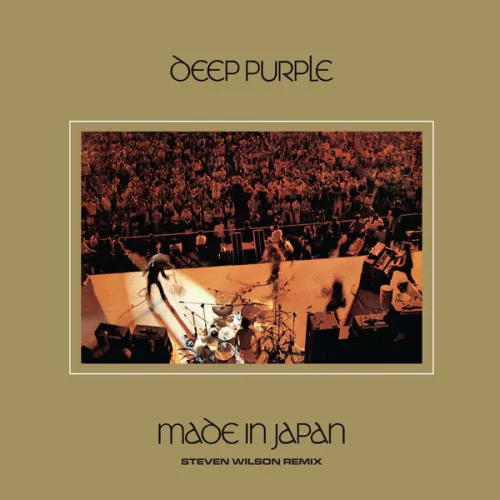
Made In Japan
Made in Japan is one of the most famous live albums ever released and a defining document of Deep Purple at their peak. Recorded during the band’s first Japanese tour in August 1972 and released later that year in Japan and in 1973 in other markets, it captures the Mk II lineup in a state of extraordinary power. The album is often described as a benchmark for live hard rock because it preserves not just the songs, but the force and spontaneity of the band on stage.
What makes the album historic is the way it transforms studio material into something larger, looser, and more dangerous. Songs such as “Highway Star,” “Child in Time,” “Smoke on the Water,” “The Mule,” and “Space Truckin’” are stretched into performances full of improvisation, tension, and audience interaction. The band does not simply reproduce the album versions; it reimagines them in real time, with extended solo sections that highlight each player’s technical strengths and group chemistry.
The record is also important because of its sound and structure. It feels immediate, raw, and vivid, yet it remains clear enough for listeners to hear how each instrument contributes to the overall drive. The live setting allows Deep Purple’s existing songs to become dramatic events, and the album’s sequencing preserves the excitement of a full concert experience rather than isolated highlights. That quality helped establish a template for what a great rock live album could be.
Commercially and critically, Made in Japan was a major success and quickly became one of the band’s most admired records. It showed that Deep Purple were not merely a studio hard rock band but an exceptionally strong live unit capable of turning long-form performance into art. The album also reinforced the idea that a live record could be a definitive statement rather than a secondary release.
Over time, the album’s reputation grew even further. It has frequently appeared in lists of the greatest live albums of all time and has been praised for its intensity, clarity, and musical daring. It became especially important to later generations of rock and metal listeners who wanted proof that live performance could be both technically demanding and emotionally explosive. For many fans, it remains the essential Deep Purple record.
A powerful part of the album’s mythology is the fact that it was recorded in Japan, a setting that gave it an exotic and almost ceremonial aura in the Western rock imagination. The shows themselves were not framed as a grand historical event at the time, but the recorded result later made them feel legendary. The very idea of a Western hard rock band delivering such a performance abroad helped add to the album’s mystique.
Urban Legends
One common legend about Made in Japan is that the album sounds almost too perfect to be live, leading some listeners over the years to wonder whether the performances were heavily altered. In reality, the record’s power comes from the band’s actual stage chemistry, but the persistence of that rumor says a lot about how polished and explosive the album feels.
Another long-running story is that the Japanese audience’s enthusiasm somehow pushed Deep Purple into even greater performance intensity, as if the band were responding to a special atmosphere that could only have existed on that tour. That idea has become part of the album’s legend, reinforcing the sense that the record captures a once-in-a-lifetime concert moment.
There is also a persistent fan belief that the album effectively defined the blueprint for the modern hard rock live album, making every later attempt feel like a response to it. While that is more interpretation than fact, it is a telling sign of the album’s reputation.
Track list
- Highway Star — 6:52.
- Child in Time — 12:16.
- Smoke on the Water — 7:30.
- The Mule — 9:28.
- Strange Kind of Woman — 9:52.
- Lazy — 10:52.
- Space Truckin’ — 19:54.
Deep Purple albums
- Shades of Deep Purple (1968).
- The Book of Taliesyn (1968).
- Deep Purple (1969).
- In Rock (1970).
- Fireball (1971).
- Machine Head (1972).
- Who Do We Think We Are (1973).
- Burn (1974).
- Stormbringer (1974).
- Come Taste the Band (1975).
- Perfect Strangers (1984).
- The House of Blue Light (1987).
- Slaves and Masters (1990).
- The Battle Rages On... (1993).
- Purpendicular (1996).
- Abandon (1998).
- Bananas (2003).
- Rapture of the Deep (2005).
- Now What?! (2013).
- Infinite (2017).
- Whoosh! (2020).


The best music in Hi-Res
Enjoy uncompromising sound quality of this album.
Try it now