History of Nómadas
Franco Battiato
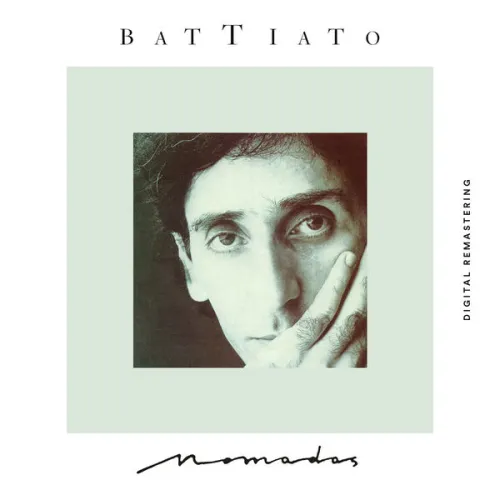
Nómadas) is the album that Franco Battiato recorded entirely in Spanish and which was released in 1987, at the height of his rise to fame outside of Italy. Conceived as an adaptation of his early-1980s repertoire for the Spanish-speaking market, the album reinterprets several of his most iconic songs from his pop era in Spanish (“Bandiera bianca”, “Voglio vederti danzare,” “La era del cinghiale bianco,” “Mal d’Africa,” “Prospettiva Nevsky,” “Un’altra vita”), along with tracks specifically written in Spanish. The album was released by EMI and aimed primarily at Spanish and Latin American audiences.
The context surrounding the release of Nómadas was that of a Battiato already well-established in Italy thanks to highly successful works such as La voce del padrone, L’era del cinghiale bianco, and Patriots, in which he had found a very personal formula for intellectual pop, full of cultural and philosophical references. That combination of accessible melodies and enigmatic lyrics made him a cult artist even outside his home country, especially in Spain, where many of his songs began to gain significant traction. Nómadas was released precisely to capitalize on that interest, offering versions adapted into Spanish that would allow for a more direct reception of his lyrical universe.
The Spanish lyrics of Nómadas largely respect the spirit of the Italian originals, though they are not always literal translations: in many cases, they are adaptations that seek to maintain the rhythm, musicality, and wordplay characteristic of Battiato, sometimes substituting cultural references or idiomatic expressions with more natural equivalents in Spanish. This is particularly evident in “Bandera blanca” (based on “Bandiera bianca”) and “Yo quiero verte danzar” (“Voglio vederti danzare”), where the ironic and almost visionary tone of the texts is preserved, but with imagery adapted to the new language.
Musically, Nómadas maintains the production, arrangements, and atmospheres of Battiato’s classic period with Giusto Pio: brilliant synthesizers, clear melodic lines, rhythms that combine the tradition of European pop with Mediterranean flair, and a very distinctive use of the voice, which alternates between almost recitative delivery and highly catchy choruses. The backbone of the album consists of Spanish-language versions of songs already tested on the Italian albums, ensuring stylistic coherence and allowing listeners to enjoy that characteristic blend of pop elegance and light experimentation.
The album received a very positive reception in Spain, where it helped definitively establish Franco Battiato as a unique figure within singer-songwriter pop. The inclusion of tracks like “Yo quiero verte danzar” and “Bandera blanca” in Spanish facilitated their airplay on radio and television, and over time the album as a whole became a reference point for those in the Spanish-speaking world encountering his work for the first time. Years later, the significance of Nòmadas has been reaffirmed by vinyl reissues and remastered editions, which keep it alive within the artist’s catalog.
History of Franco Battiato
Franco Battiato (1945–2021) was an Italian singer-songwriter, composer, painter, and filmmaker, considered one of the most original and eclectic artists in European popular music. Born in Sicily, he began his career in the 1960s, moving between singer-songwriter music, light pop, and experimentation, until he ventured into the 1970s into the realms of progressive rock, electronic music, and the avant-garde, with albums that placed him within the orbit of Italian experimental music. This early phase, less well-known to the general public, allowed him to develop his own musical language and an almost boundless curiosity for mixing styles.
In the late 1970s and early 1980s, Battiato made his major shift toward pop, without abandoning conceptual depth. Albums such as L’era del cinghiale bianco (1979), Patriots (1980), and, above all, La voce del padrone (1981) turned him into a massive phenomenon in Italy, thanks to songs like “Centro di gravità permanente,” “Bandiera bianca,” “Prospettiva Nevsky,” and “Voglio vederti danzare.” In these works, he combined catchy melodies with lyrics rich in philosophical, historical, and spiritual references, achieving a rare balance between intellectual ambition and popular success.
During the 1980s and 1990s, Battiato continued to explore various directions: electronic pop, contemporary music, Eastern influences, Christian and Sufi mysticism, as well as collaborations with other artists (for example, with the singer Alice). At the same time, he developed an interest in opera and symphonic music, composing more academically oriented works and delving deeper into a spiritual path that was reflected in many of his lyrics. His discography gradually filled with albums that alternated between the accessible and the experimental, without ever losing a very distinct personality.
In the Spanish-speaking world, his impact was particularly boosted by the Spanish adaptations of part of his repertoire, such as those included in Nómadas. Thanks to this, Battiato became a point of reference for several generations of listeners and musicians in Spain and Latin America, who found in him a model of singer-songwriter pop capable of being cultured, ironic, spiritual, and deeply melodic all at once. Throughout his career, he established himself as a true “total artist,” interested not only in music but also in painting, film, and philosophical reflection.
Until his final years, Battiato continued to release albums and revisit his own repertoire, often in a more stripped-down and intimate style. His legacy is recognized today in both Italian music and the canon of European pop, and his influence spans very different genres, from singer-songwriter music to the most contemplative electronic music. The blend of Mediterranean sensibility, intellectual curiosity, and subtle humor that characterizes his work ensures that albums like Nómadas remain unique and relevant despite the passage of time.
Songs from Nómadas with durations
- Nómadas – 4:16
- Bandera blanca – 4:40
- Yo quiero verte danzar – 3:35
- Vía láctea – 4:40
- The Age of the White Boar – 3:40
- Waking Up in Spring – 4:20
- Mal de África – 4:25
- Nevsky Perspective – 4:30
- Another Life – 4:10
Franco Battiato's Discography (Major Albums)
- Fetus (1972)
- Pollution (1972)
- Sulle corde di Aries (1973)
- Clic (1974)
- Mademoiselle le “Gladiator” (1975)
- Battiato (1976)
- L’era del cinghiale bianco (1979)
- Patriots (1980)
- La voce del padrone (1981)
- L’arca di Noè (1982)
- Orizzonti perduti (1983)
- Mondi lontanissimi (1985)
- Nómadas (1987)
- Physiognomics (1988)
- Red Jackets (1989)
- Like a Camel in a Gutter (1991)
- Café de la Paix (1993)
- The Umbrella and the Sewing Machine (1995)
- Shellac (1998)
- Fleurs (1999)
- Fleurs 3 (2002)
- Ten Stratagems (2004)
- The Void (2007)
- Inner Eye – The Whole Is Greater Than the Sum of Its Parts (2009)
- Open Sesame (2012)